There are some experiences you can prepare for physically, plan for months, research endlessly, and still never fully understand until you live them.
Climbing Mount Kilimanjaro was one of those experiences.
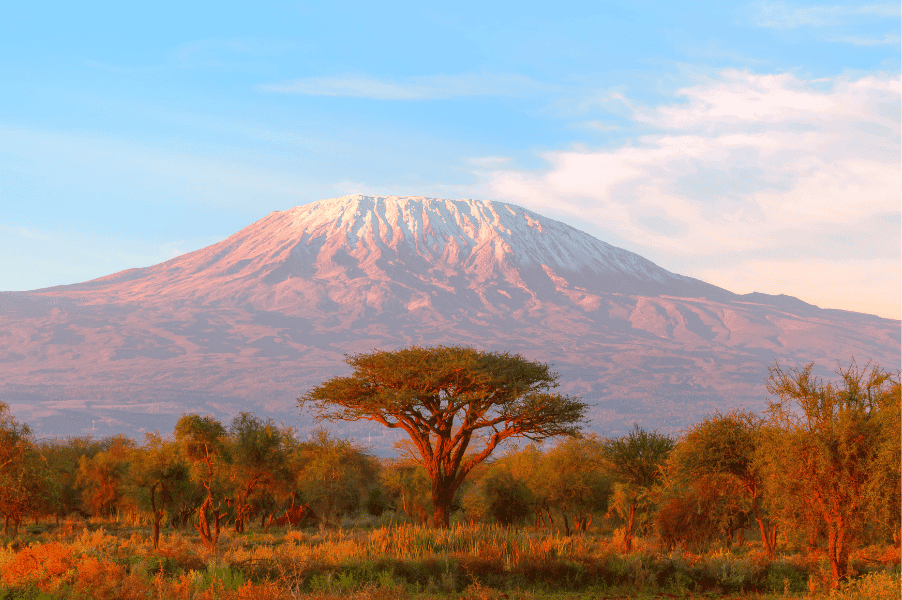
On September 24, Lori and I began our journey up the Machame Route with one destination in mind: Uhuru Peak, 5,895 metres above sea level — the highest point in Africa.
But this climb was never simply about reaching a summit.
Through our Climbing Higher Together campaign, we wanted to recognize the resilience we see every day at Pillars of Wellness and raise awareness and funds for mental health through the Centre for Addiction and Mental Health (CAMH).
What we discovered over seven days was that Kilimanjaro has a way of stripping life down to its simplest elements.
Walk. Breathe. Eat. Drink. Rest. Repeat.
And eventually, even breathing becomes something you have to think about.
Day 1: Machame Gate to Machame Camp — The Adventure Begins
Machame Gate: approximately 1,640–1,800 m
Machame Camp: approximately 3,000 m
The journey began beneath a canopy of dense rainforest.
Everything was green, humid and alive. The trail climbed steadily through the forest as we settled into the rhythm that would define the week ahead.
Pole pole — slowly, slowly.
At first, that pace almost seemed unnecessarily slow. We felt strong. Our legs were fresh. Our packs were organized. The summit still felt very far away.
But Kilimanjaro rewards patience.
By the time we reached Machame Camp, we had already gained well over 1,000 metres of elevation. Our first tents were waiting for us, along with something we would quickly learn never to take for granted: a hot meal.
That first evening also introduced us to our new reality.
Our tent was now our bedroom, dressing room, storage space and shelter.
Two people, sleeping bags, duffel bags, clothes, boots and equipment all had to somehow coexist inside a very small space.
Getting changed required planning.
Finding something buried at the bottom of a bag became an expedition of its own.
And this was only night one.
Day 2: Machame Camp to Shira 2 Camp — Leaving the Forest Behind
Shira 2 Camp: approximately 3,810–3,840 m
The landscape changed dramatically on our second day.
The rainforest gradually disappeared and gave way to open moorland, rock and sweeping views across the Shira Plateau.
For the first time, the scale of Kilimanjaro really began to reveal itself.
And so did the altitude.
At almost 4,000 metres, the air was becoming noticeably thinner. The mountain was also becoming drier.
Our lips dried out. Our noses became irritated. Dust found its way onto our clothes, equipment and faces.
The comfortable oxygen-rich environment we take for granted at home was slowly disappearing.
Walking remained manageable, particularly when we maintained our slow pace.
It was the small things that were surprising.
Bending over to tie a boot.
Opening a duffel bag.
Changing clothes.
Organizing equipment.
Sometimes you would stand back up after doing something completely ordinary and suddenly realize:
I’m out of breath.
That was when Kilimanjaro began teaching us an important lesson.
At altitude, there are very few “small” efforts.
Day 3: Shira 2 to Lava Tower and Barranco Camp — Climb High, Sleep Low
Shira 2: approximately 3,840 m
Lava Tower: approximately 4,630 m
Barranco Camp: approximately 3,976 m
Day three was one of the most important acclimatization days of the expedition.
We climbed toward Lava Tower, rising above 4,600 metres for the first time.
The vegetation became sparse. The landscape became increasingly barren. Dust and volcanic rock replaced much of the greenery we had left behind.
And the air became noticeably thinner.
Every uphill section demanded more concentration.
You learn quickly that fighting the mountain is pointless.
You shorten your stride.
You control your breathing.
You follow the person ahead of you.
And you keep moving.
After reaching Lava Tower, we descended to Barranco Camp. This “climb high, sleep low” strategy is one of the reasons the seven-day Machame Route allows the body more time to acclimatize.
Barranco also gave us one of the most dramatic sights of the entire expedition.
Towering above camp was the Barranco Wall.
And tomorrow morning, we were going straight up it.
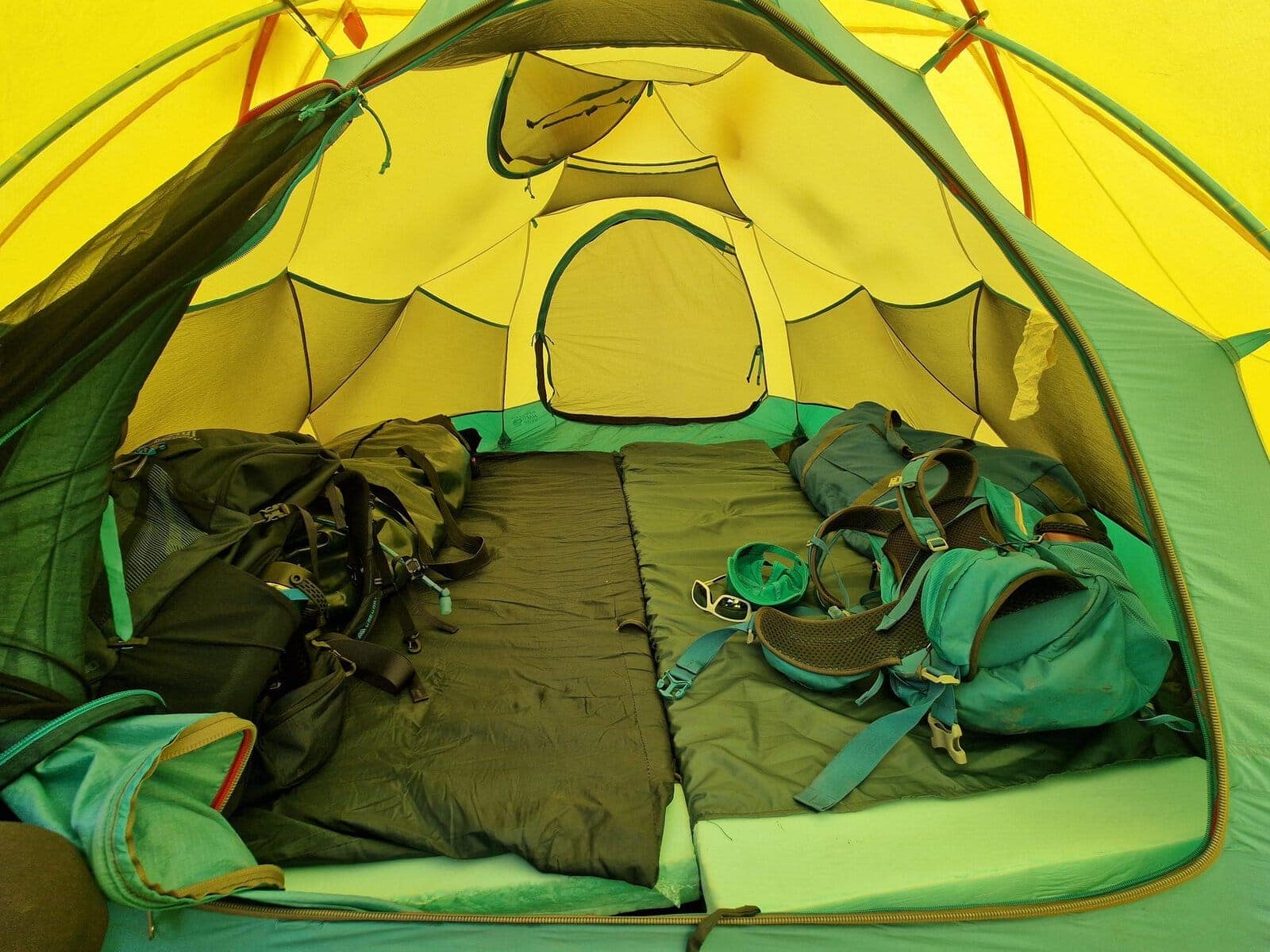
Tent on Kilimanjaro
Day 4: Barranco Camp to Karanga Camp — Taking on the Barranco Wall
Barranco Camp: approximately 3,976 m
Karanga Camp: approximately 3,995 m
From below, the Barranco Wall looks intimidating.
It rises almost directly out of the valley, with a line of climbers slowly zigzagging upward across the rock.
Once we started climbing, however, intimidation turned into excitement.
This was different from simply hiking uphill.
There were sections where we used our hands. Places where we carefully stepped around rock faces. Moments where we stopped and looked back at the enormous landscape opening beneath us.
Our guides were always there.
A hand when necessary.
A direction.
A warning about a loose rock.
A reminder to slow down.
Eventually, we reached the top.
And that moment was spectacular.
But Kilimanjaro rarely lets you celebrate for too long.
There were more valleys to cross, more climbing and eventually another descent before the final approach into Karanga Camp.
By now, fatigue was accumulating.
Not the fatigue of one difficult workout.
This was day-after-day fatigue.
You slept, but never quite as comfortably as at home. Your muscles recovered, but never completely. The dry air continued to affect your throat and nose. Dust seemed permanently attached to everything.
And every morning, you packed it all up and started walking again.
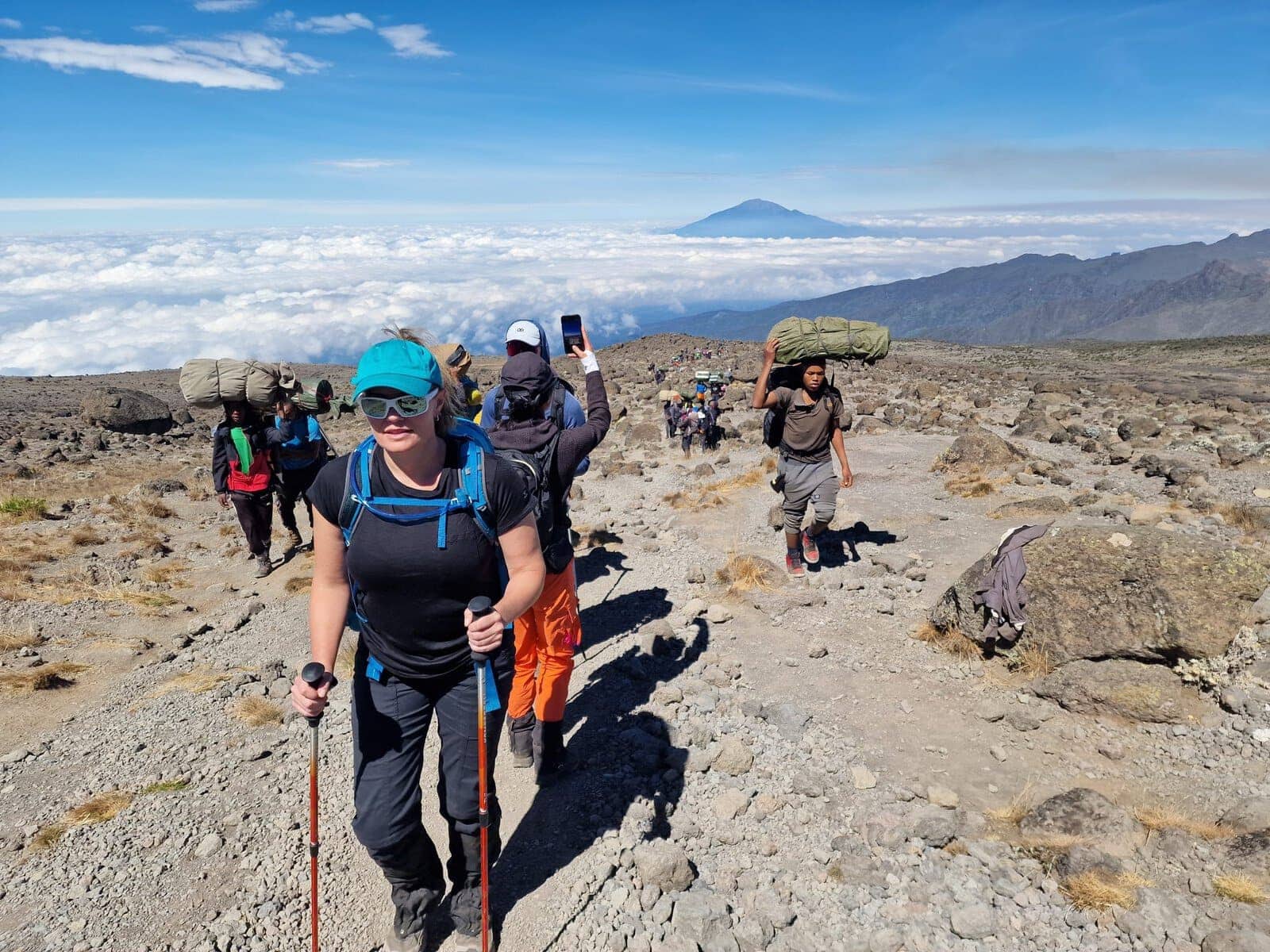
Hiking on the roof top of Africa
Day 5: Karanga to Kosovo Camp — Entering the Thin Air
Karanga Camp: approximately 3,995 m
Barafu Camp: approximately 4,673 m
Kosovo Camp: approximately 4,870 m
This was when Kilimanjaro began to feel truly serious.
We climbed steadily from Karanga toward Barafu, the traditional high camp used by many climbers preparing for their summit attempt.
But Barafu wasn’t our final destination.
We continued upward.
Our final camp would be Kosovo Camp, at approximately 4,870 metres — nearly 16,000 feet above sea level.
There was very little vegetation left.
Just rock, volcanic terrain, cold, dust and sky.
And thin air.
Very thin air.
This was perhaps one of the strangest parts of the experience.
You could be sitting quietly and feel reasonably good. Then you would decide to change your socks, organize your backpack or tie your boots.
Suddenly you were breathing heavily.
Packing and unpacking our bags became tiring.
Getting dressed became tiring.
Moving around inside the tent became tiring.
Even preparing yourself to go to sleep took effort.
At sea level, these activities are almost meaningless physically.
At nearly 4,900 metres, your body notices everything.
Then there was the tent.
After several nights, the novelty of camping had definitely disappeared.
The space felt smaller every night.
Your equipment seemed to multiply.
Your sleeping bag never quite stayed where you wanted it.
Getting up required manoeuvring around bags, clothing and another person.
Comfort was no longer part of the equation.
And yet, outside that tiny tent stood one of the most extraordinary landscapes we had ever seen.
Above us was the summit of Africa.
We were almost there.
The People Who Made the Mountain Possible
There is something important about climbing Kilimanjaro that photographs of the summit can never fully explain.
You do not climb this mountain alone.
Behind every climber is an extraordinary team.
Our guides watched our pace, our breathing, our energy and our condition.
Our porters carried loads up terrain that challenged us while carrying only our daypacks.
And somehow, after we had spent hours walking, we would arrive at camp to discover that our camp team had already reached it.
Our tents were standing.
Our equipment was there.
Water was being prepared.
And food was coming.
The organization behind the scenes was remarkable.
And our cook deserves special recognition.
The food was amazing.
Considering where we were, what was being carried up the mountain and the conditions in which meals were being prepared, we were continually surprised by how good the food was.
Warm soups, carbohydrates, proteins and hot meals became something we looked forward to after hours on the trail.
Food wasn’t just fuel anymore.
It was comfort.
It was morale.
It was one of those small moments each day when everyone could sit together and temporarily forget about how many meters still separated us from the summit.
Our achievement belongs in part to every person on that mountain who helped us get there.
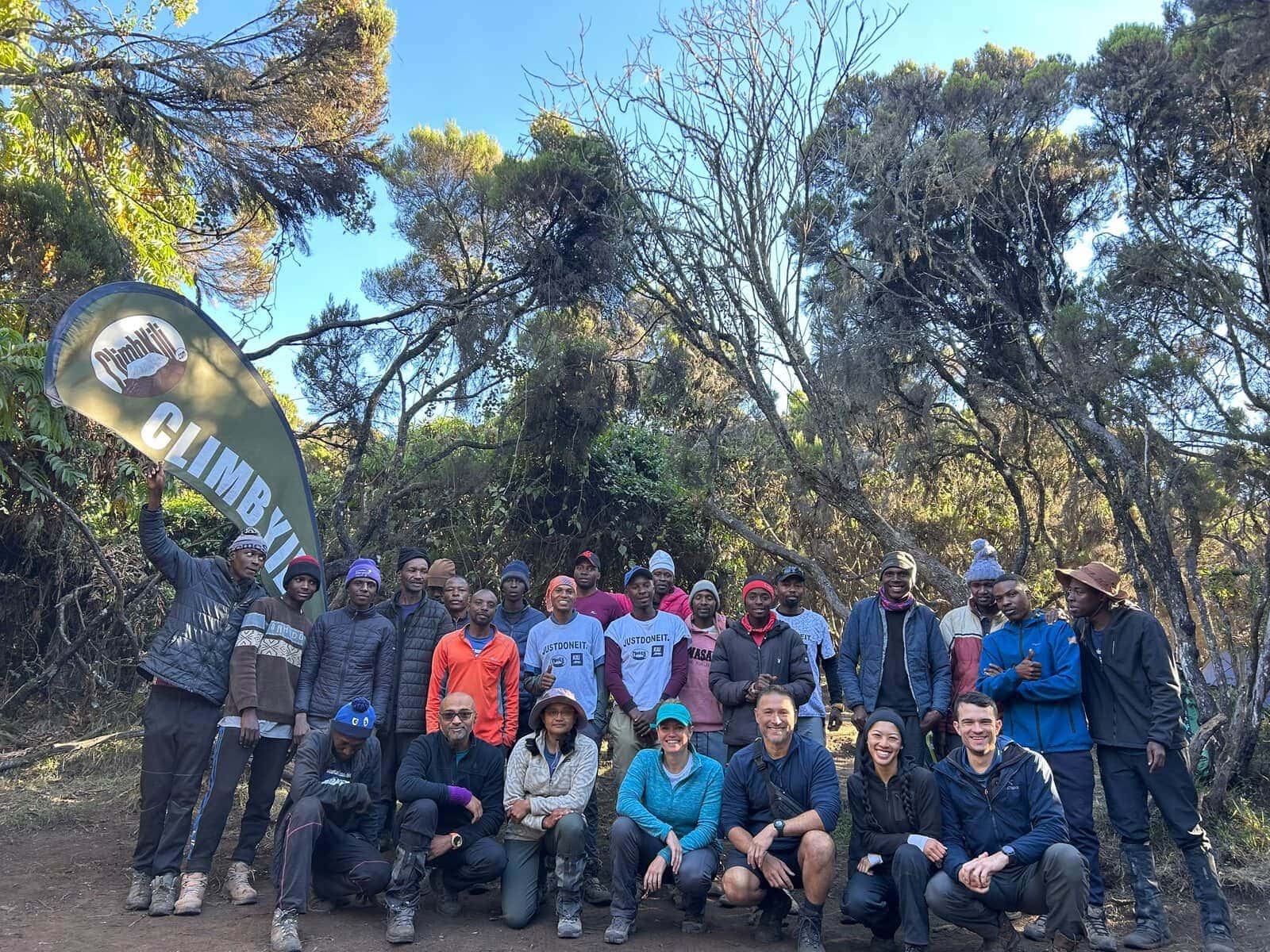
Our Support Team – Climb Kili
Summit Night: Kosovo Camp to Uhuru Peak — Into the Darkness
Kosovo Camp: approximately 4,870 m
Stella Point: approximately 5,756 m
Uhuru Peak: 5,895 m / 19,341 ft
Then came the night we had been thinking about for months.
Summit night.
We left Kosovo Camp in darkness.
Headlamps illuminated only a small section of trail ahead of us.
Beyond that circle of light was blackness.
The climb became almost meditative.
Step.
Pole.
Breathe.
Step.
Pole.
Breathe.
There was no reason to think about the entire mountain anymore.
The only useful objective was the next step.
As we climbed higher, the oxygen continued to decrease and every movement became more demanding.
Fatigue accumulated.
The cold surrounded us.
The trail seemed endless.
And somewhere during those final hours, the challenge stopped being primarily about our legs.
It became mental.
Your body wants rest.
The summit still seems impossibly far away.
But you keep moving.
Pole pole.
Slowly.
Always forward.
The Final Hours — When the Mountain Asked Everything From Us
The final portion of the climb was the hardest part of the entire expedition.
Above 5,000 meters, the thin air changed everything.
Our pace slowed dramatically.
Simple movements required concentration.
Fatigue that had accumulated over several days was now combined with severe altitude, cold and lack of sleep.
There were moments when the body simply felt depleted.
But somewhere ahead was Stella Point.
And beyond Stella Point was Uhuru Peak.
We continued.
One step at a time.
Eventually, darkness began giving way to morning.
The horizon changed color.
The mountain slowly appeared around us.
And after days of looking upward toward Kilimanjaro, we were suddenly looking across the roof of Africa.
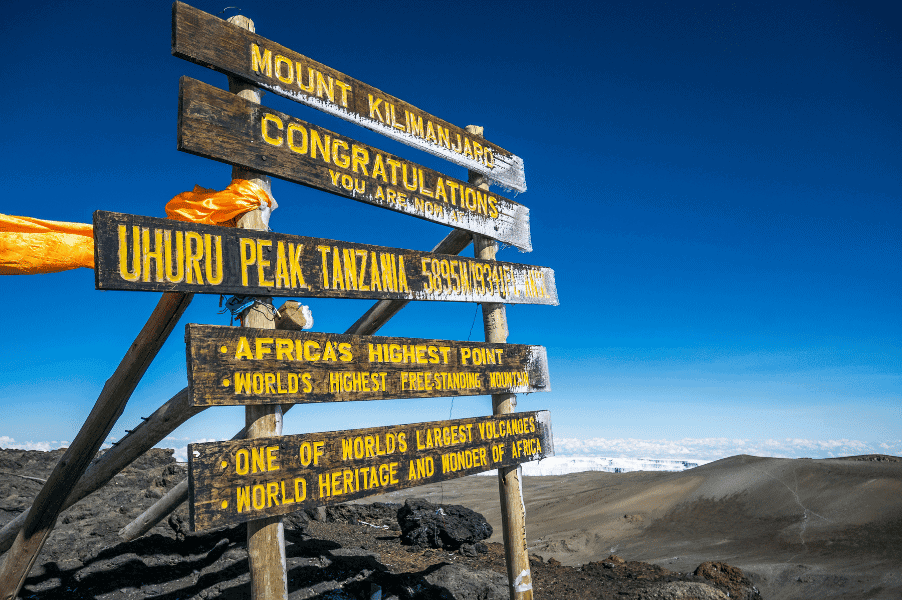
Uhuru Peak — 5,895 Meters
Then we saw it.
The summit sign.
Uhuru Peak.
5,895 meters.
19,341 feet.
The highest point in Africa.
We had made it.
Months of preparation.
Days of climbing.
Dust.
Cold.
Dry air.
Exhaustion.
Uncomfortable nights.
Thousands upon thousands of steps.
All of it had brought us here.
Standing at the summit was emotional because the achievement wasn’t simply about reaching 5,895 meters.
It represented everything required to get there.
Preparation.
Patience.
Teamwork.
Adaptation.
Determination.
And resilience.
Those were exactly the ideas behind Climbing Higher Together from the beginning.
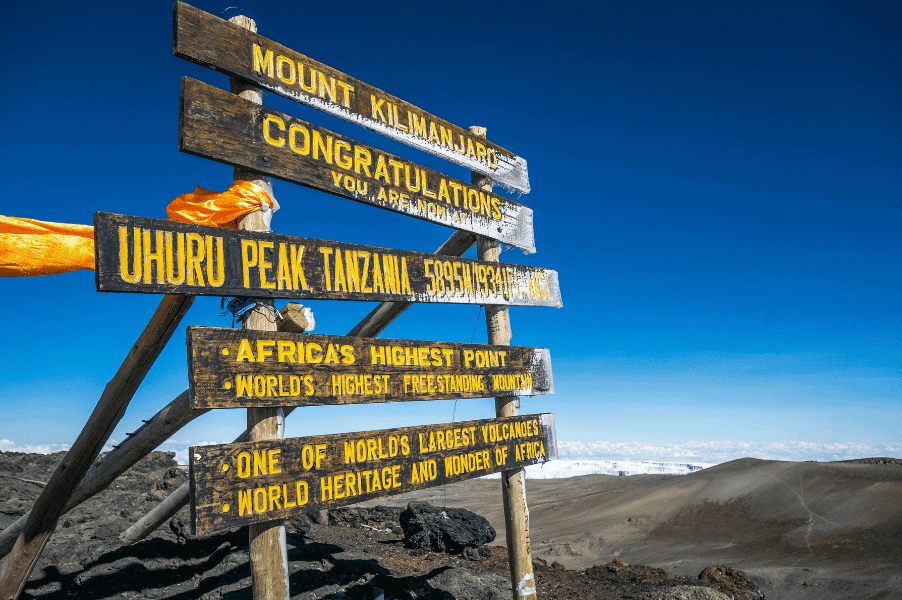
uhuru peak
The Summit Wasn’t the Finish Line
There is one thing photographs at Uhuru Peak don’t show.
You still have to get down.
After reaching the highest point in Africa, we turned around and began the long descent.
Back toward Kosovo and Barafu.
Down through the barren alpine landscape.
Eventually toward Mweka Camp at approximately 3,100 meters.
The descent was long and demanding on already exhausted legs.
But something remarkable happens as you lose altitude.
The air begins to feel different.
Breathing becomes easier.
Vegetation eventually returns.
The mountain slowly gives your body back the things it had taken away.
After days of constantly climbing higher, going down felt almost surreal.
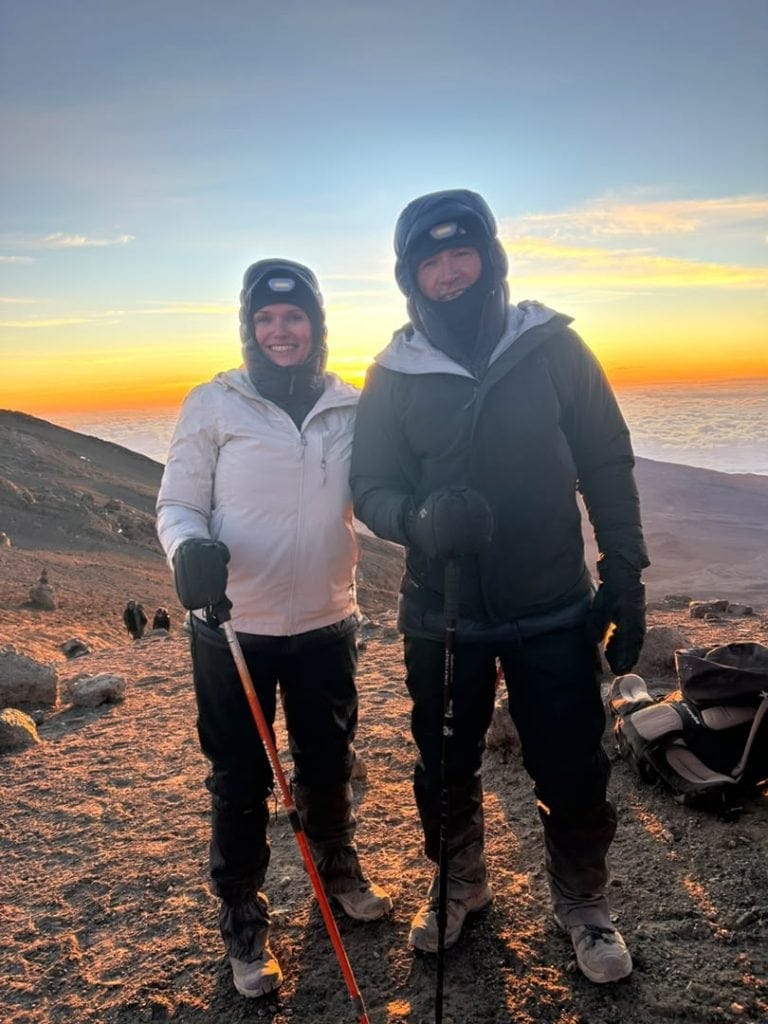
Lori and Laurent on top of Kilimanjaro
Day 7: Mweka Camp to Mweka Gate — The Final Steps
Mweka Camp: approximately 3,100 m
Mweka Gate: approximately 1,640 m
Our final morning took us back into the rainforest.
The landscape that had disappeared days earlier returned around us.
Trees.
Humidity.
Dense vegetation.
And oxygen.
Lots of wonderful oxygen.
Step by step, we descended toward Mweka Gate.
And then suddenly there were no more kilometers to walk.
No more camp to reach.
No more tent to organize.
No more boots to lace up for tomorrow.
We had climbed Mount Kilimanjaro.
What Kilimanjaro Taught Us
Before this expedition, it was easy to think about Kilimanjaro in numbers.
5,895 meters.
Seven days.
Approximately 60 kilometers.
Five ecological zones.
But after climbing it, those numbers seem almost irrelevant.
What stays with us are the moments.
Standing beneath the Barranco Wall wondering how we were going to climb it.
Trying to find a clean pair of socks inside a chaotic tent.
Laughing about how exhausting it had become simply to get dressed.
Dust on our faces.
Dry throats.
Cold mornings.
Hot meals.
The encouragement of our guides.
Watching porters move confidently past us on the trail.
Seeing our tents waiting in the distance after a long day.
Looking upward at a sky filled with stars.
And finally watching the African sunrise from almost six kilometers above sea level.
Kilimanjaro was uncomfortable.
It was exhausting.
At times, it was incredibly difficult.
And it was absolutely extraordinary.
Climbing Higher Together
We originally called this journey Climbing Higher Together because we wanted the mountain to represent something larger than ourselves.
Through our work at Pillars of Wellness, we meet people every day who are climbing mountains that don’t appear on maps.
Recovering from injury.
Living with chronic pain.
Adapting to neurological conditions.
Working through mental health challenges.
Rebuilding confidence.
Trying again after setbacks.
Their mountains may look very different from Kilimanjaro, but resilience often works the same way.
You don’t have to conquer everything at once.
Sometimes you simply take the next step.
And then another.
And another.
Our journey to Uhuru Peak at 5,895 meters is now finished.
But the message behind it remains.
The mountain reminded us that extraordinary things rarely happen because of one heroic moment.
They happen because people keep moving when things become uncomfortable.
Because someone encourages you when your energy disappears.
Because a team supports you when you cannot do everything yourself.
And because sometimes the biggest mountains become possible when we climb them together.
We went to Kilimanjaro hoping to reach the summit.
We came home understanding much more clearly what it means to keep climbing.